How to release TV shows in 2026
I found this report from Luminate media to be fascinating. It's called "Release Strategies for Music & TV" and it's a guide for music and TV producers how how to find success in the oversaturated media landscape we find ourselves in today. A few specific things stand out to me on the TV front in particular.
For all the criticism lobbed against the all-episodes-at-once (or “binge”) release cadence, it remains prevalent even outside of Netflix. […] The binge strategy does possess certain advantages, such as inflating first-week engagement and thus potentially securing a high spot on weekly ranking charts, which can further positive word of mouth for the series. On the other hand, binge-release viewership tends to decay quickly, whereas a weekly-release hit can remain on the charts week after week, continuously drawing new eyes.
I hadn't really considered it, but of course releasing a whole season at once is a cheeky way to boost engagement on that first wee, driving you up the streaming top charts. Giving your biggest fans the opportunity to spend 10 hours watching your show in a week is quite a boost compared to capping them out at 1 hour.
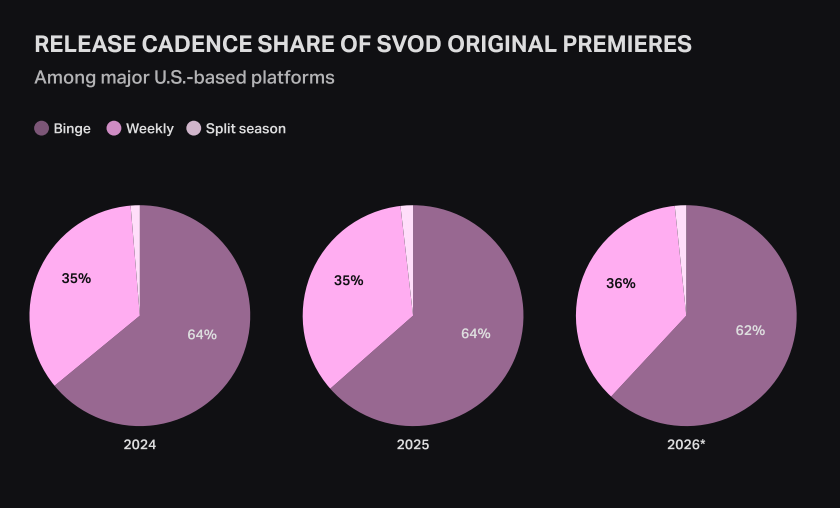
They also have some data on how many shows are doing each release strategy. The data over the last 3 years shows effectively no movement, with a third of shows releasing weekly, two thirds releasing all at once, and a vanishingly small number splitting their season.
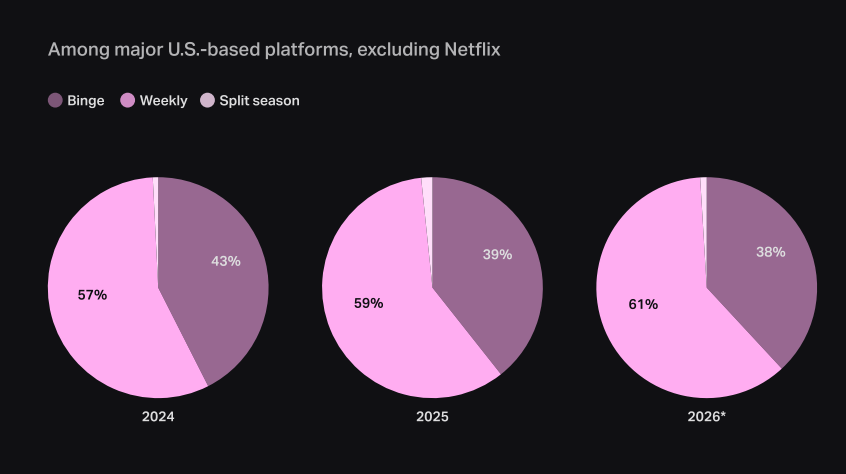
Notable though, when you exclude Netflix from that breakdown, we do see a notably different story. More than half of shows are weekly and that number is creeping up a few percent each year recently.
Lengthy gaps between seasons have been a persistent headache for streamers, with the annual premieres once met even by blockbuster cable series like Game of Thrones no longer standard procedure. And while megahits such as Stranger Things can still return after multiyear breaks to massive viewership, a long hiatus (more than 1.5 years) for streaming series typically leads to a reduced audience, at least in the U.S. market. Average views dropped for every title in a sampling of recent hits — even Stranger Things, down nearly 25% in its final season.
I think this aligns with what we intuit about these big breaks in shows. Creators might hope that absence makes the heart grow fonder, but in a world with near limitless options, absence actually makes you move onto something else. Inset something here about me constantly talking about how video games also have this problem.