MacBook Neo, the benchmarks
I wrote in my review that I didn't think benchmarks told the real story of using a Neo, and I specifically called out the Geekbench CPU single-core test as particularly misleading. That said, I do think the benchmarks are interesting academically, and in terms of what they say about the differences between Apple silicon Mac chips and iPhone chips.
All charts created with my free Benchmark Studio website.
Disk speed
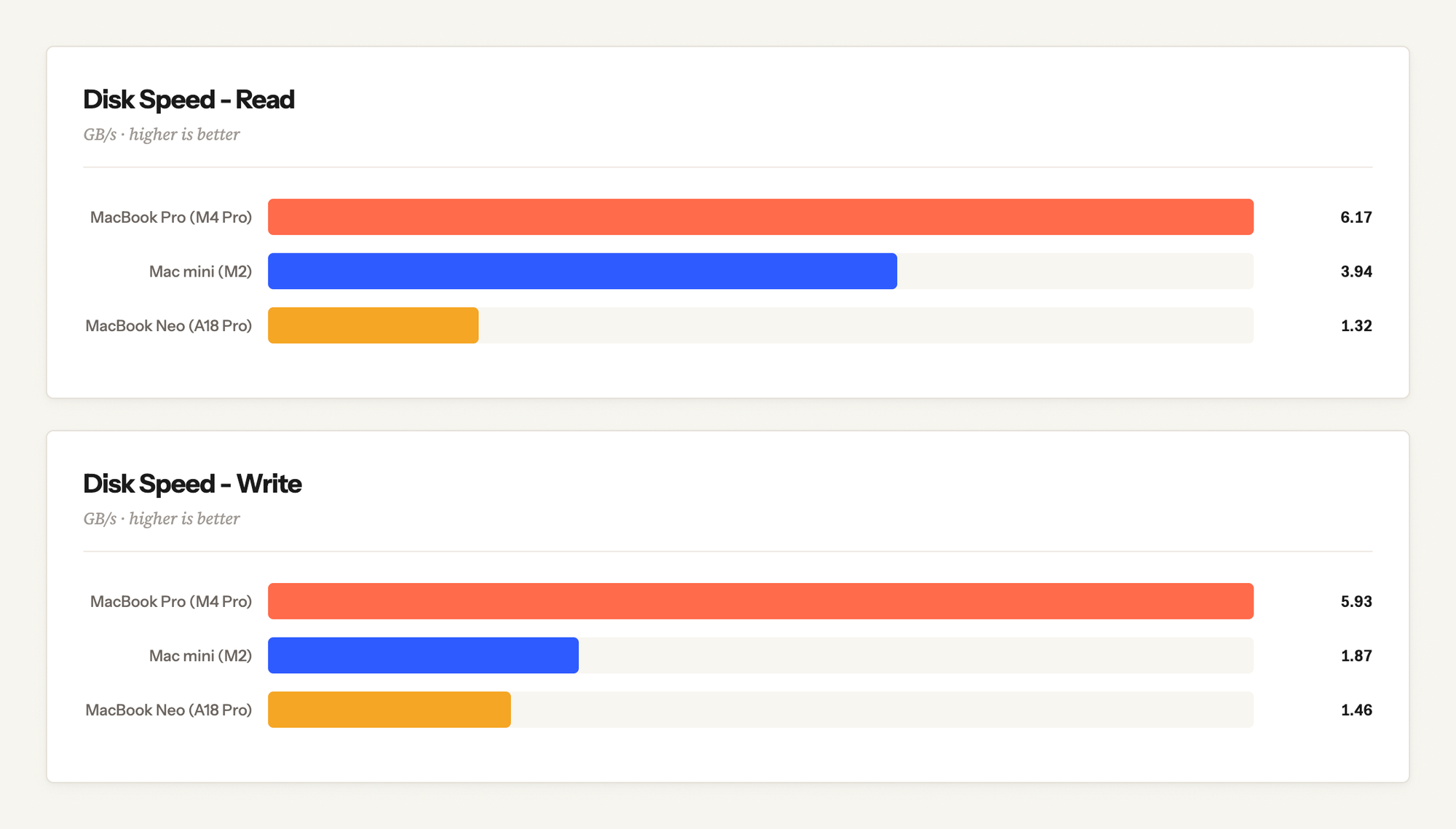
I used Magic Disk Benchmark to test the read and write speeds of the 3 Macs I have access to (and can install a random disk app on, aka not my M5 Pro work Mac). As you can see, there's a pretty enormous gap between the Neo and even a base M2 Mac mini.
In real-world use, this hasn't been a real issue for me, even dealing with relatively large video files. And I think that's likely because even at these massively reduced speeds compared to my MacBook Pro, the bottleneck in these data transfers is seldom the internal disk and is more often the remote connection to something like my NAS or the USB speeds of my SSD or my SD card from my Canon camera, which is way slower than this anyway.
What I will say is that in recent years, Apple has really accelerated the performance of their SSDs. And this has been a key part of the argument as to why PCs are absolute trash. And it turns out that even when you reduce the SSD speed by quite a bit, you can create a computer that people love and can do everything just fine on. Obviously, I hope Apple keeps pushing forward because more performance is never bad in this regard. But I would, as I so often seem to do, remind people that a lot of the specs in our modern computers are actually better than they strictly need to be, and maybe we should settle down with the fanboy talk.
Geekbench CPU single-core
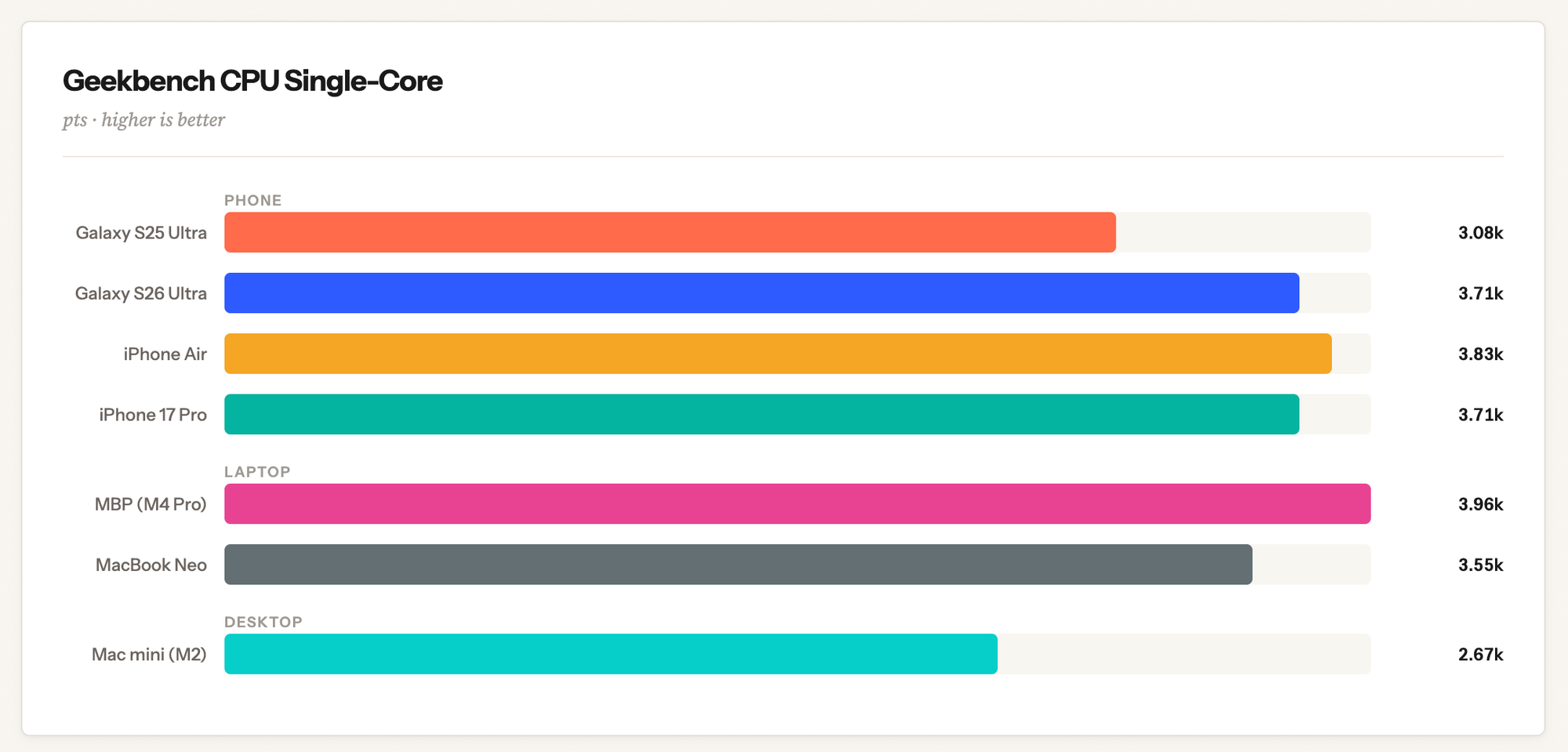
Let's share a version of the god-forsaken chart that makes everyone think the Neo is basically a pro machine. A couple of things worth calling out here are, yes, the MacBook Neo performs in the ballpark of the best ARM devices on the market today, which makes sense as it was the best iPhone chip just one year ago. Meanwhile, the older M2 is left in the dust.
I know this is a blog post about the Neo, but I did want to mention the Galaxy S26 Ultra as well, which pulls right alongside the iPhone 17 Pro in terms of single-core performance. If Apple had a substantial lead in this category in years past, the Snapdragon chips of today have effectively caught up in this regard.
Geekbench CPU multi-core
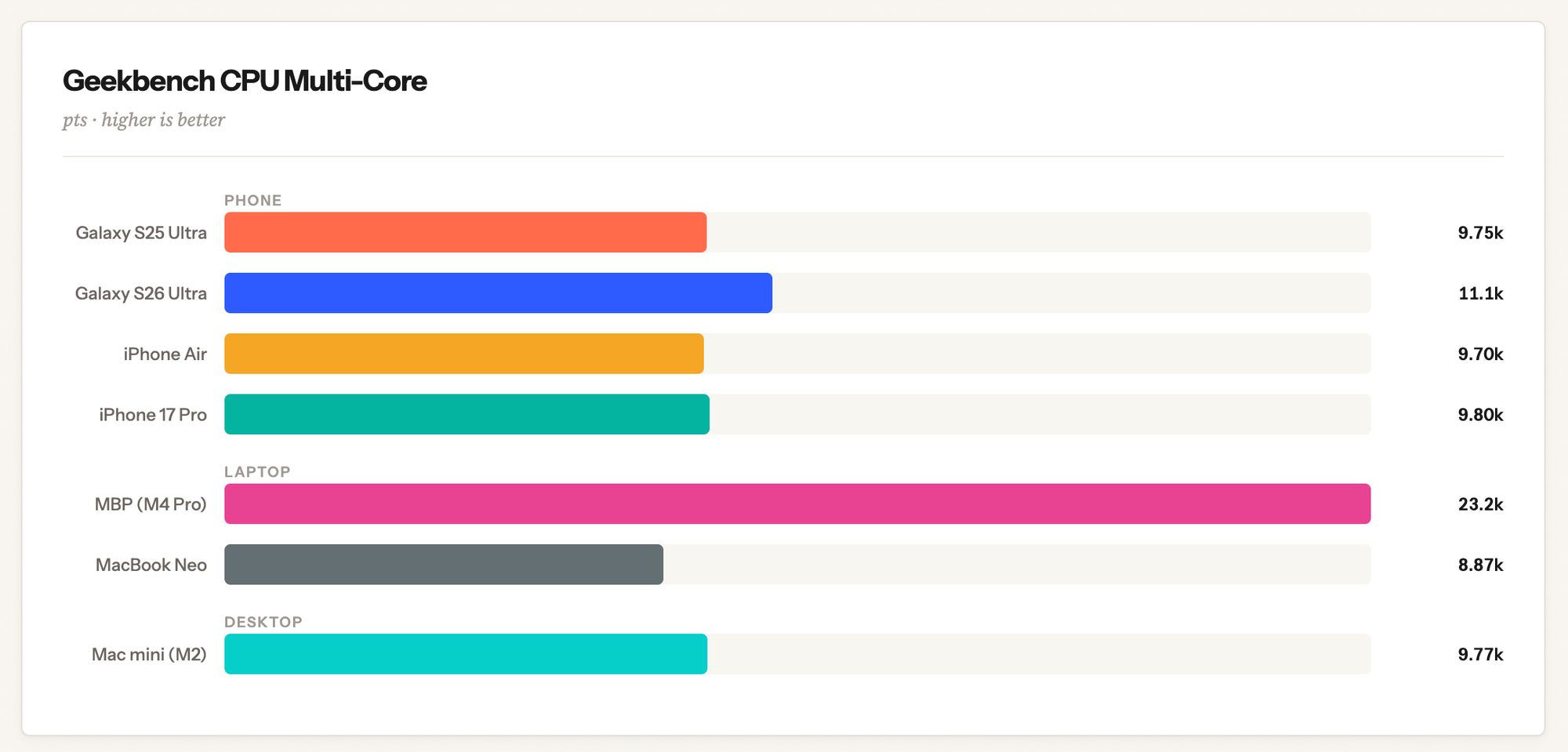
This is where the Pro version of the M4 really stretches its legs with its 14 CPU cores (10 fast, 4 slow) compared to the Neo's 6 cores (2 fast, 4 slow). This is where the experience when opening more than a couple browser tabs or more than a handful of apps gets the Neo to beg for mercy while the Pro doesn't break a sweat. That's what the 3.5x cost of my MacBook Pro is getting me, so not exactly surprising (the 3x RAM in the Pro helps as well).
I think the M2 is interesting in this comparison as well, as it is about 10% faster than the Neo in this regard with its 8 CPU cores (4 fast, 4 slow).
I'll also call out the Galaxy S26 Ultra for pushing reasonably past the latest iPhones. Again, the extensive lead Apple enjoyed here for years has vanished in benchmarks. Maybe people shouldn't be so surprised when Google says that Chrome is faster on Android than Safari on iOS.
Audio conversion
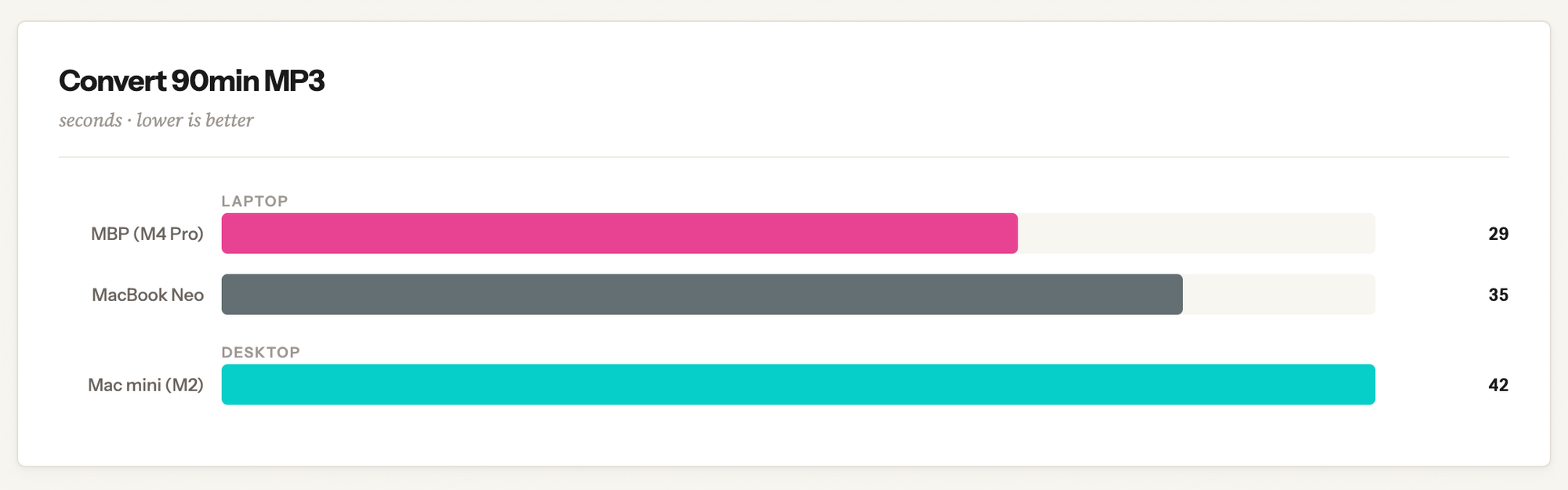
Audio conversion is a pretty straightforward single-core task on the CPU, and as you might expect, the Neo punches above its weight here, using one of its performance cores to its fullest to perform a task just seconds slower than a much more expensive Mac.
Also, the M2 lags behind, which makes sense given the Geekbench scores above.
Apple's on-device audio transcription
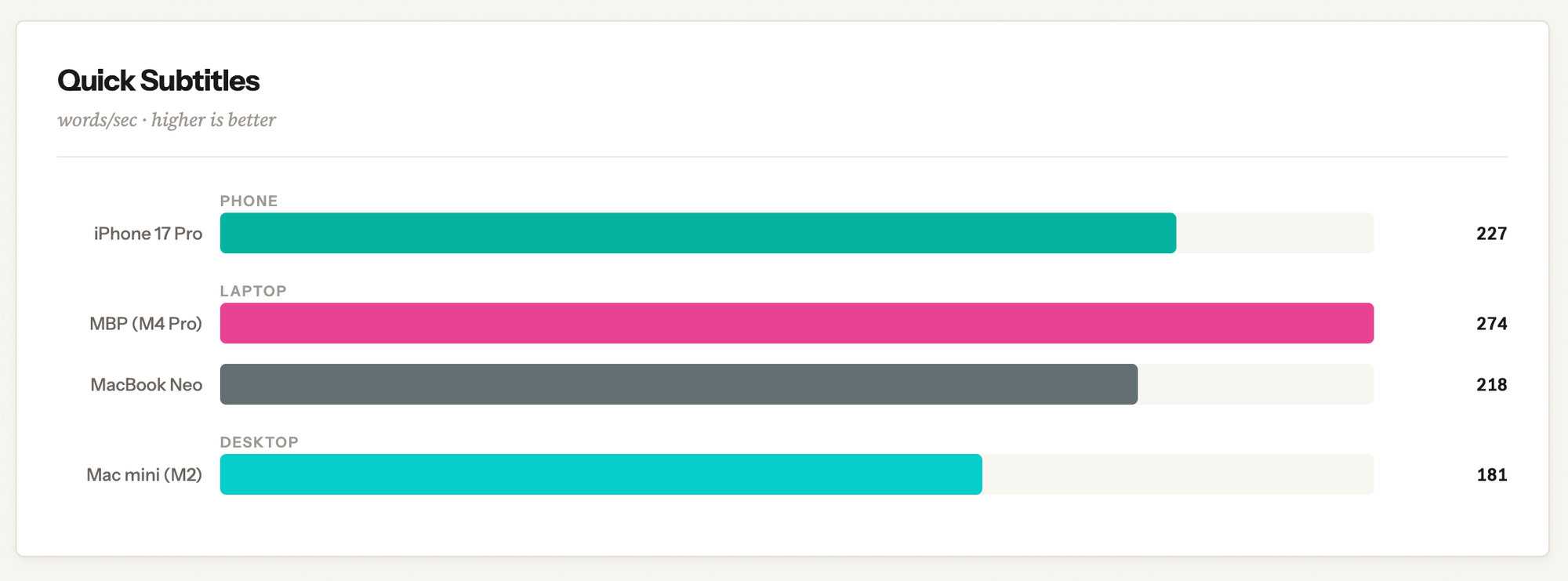
I ran Quick Subtitles' benchmark mode on each device using Apple's transcription model, and this is the words-per-second speed on each device. I think this is an interesting test, although it is quite specialized around one use case. Transcription involves a combination of the neural engine, GPU, and a little CPU.
What's notable here is that the enormous increase in CPU and GPU cores on the MacBook Pro don't lead to significant gains in performance in this task, specifically. I can see why Marco thinks the M4 and M4 Pro are quite similar if this was his main benchmark when developing Overcast's awesome new transcription feature. In fact, the Neo is really competitive here, finishing the task slower than a high-spec Mac, but not by a huge amount. I think this test shows clearly how important the neural engine is in this task, and the Neo's quite modern one helps it churn through this work quite well.
Build an iOS app
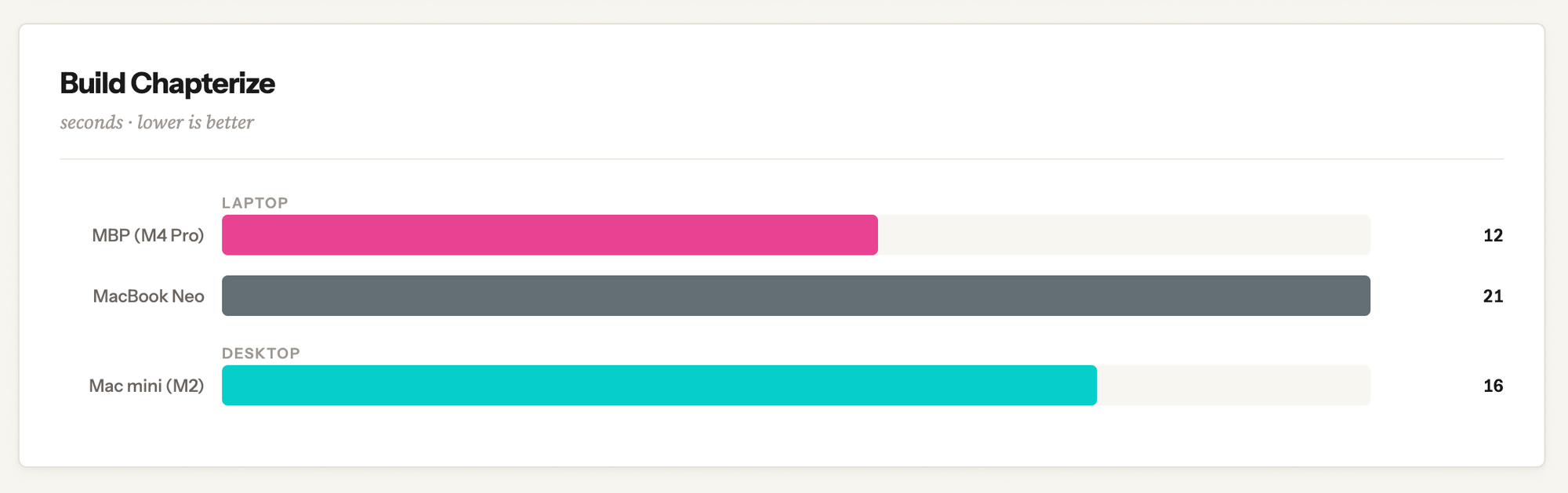
Then I went over to Xcode, opened my Chapterize project, cleaned the build folder, and ran the app. The time is how long it took for the project to build and fully launch Chapterize. This is where we get into the "it's fine, but it's not amazing" territory.
Export a video
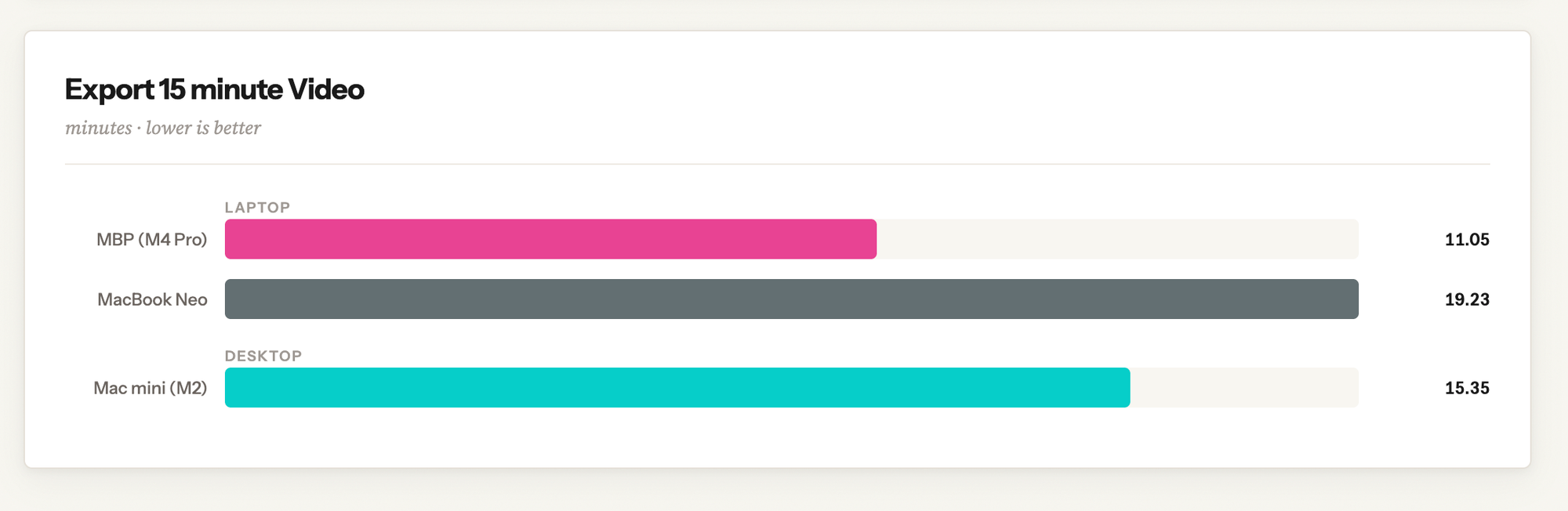
This was an export from DaVinci Resolve of my most recent A Better Computer podcast episode, which was a 15 minute, 4K 60fps video (exporting in h265 in an mp4 container). I was able to edit quite well, and the export was a good deal slower than the M4 Pro, and even the M2, but it does still work. Don't let anyone tell you that you can't do creative work on any Mac.
But what does it all mean?
The reason I didn't put these in my review is that I simply don't think they communicate the actual experience of using a computer most of the time. Not tested here is what it's like doing these things without closing all other apps first. It doesn't test what your computer feels like when these tasks are happening. It does, at least, show that a Mac powered by an iPhone chip is still remarkably capable, even if most things take a little longer to happen.
Also, I'm so glad I had an M2 around to test out my crazy theory that a similarly priced M2 MacBook Air would be a pretty damn compelling alternative to the Neo.
As I said at the start, it's academically interesting to see this stuff, and I like it as a nerd, so I had to share.