More on the messy economics of streaming music
Earlier today I wrote about why I think the pay-per-stream metric is a bad singular reference point, and doubly so when it's used as a cudgel in the fanboy wars to show why your brand is better than someone else's brand. Jason Dettbarn, who is closer to the music industry than me, wrote up a reply at his Crucial Tracks blog:
I get that bands currently make more money on Spotify in total, but if bands/fans/etc. keep advocating and the listening behavior switches to better paying services (or forces Spotify to pay more), then that's a good thing.
This is a fair retort. Putting pressure on Spotify to increase the payout pool and reduce their profits is worth doing. My intention was more to point out that when people pay in so little for access to all the music in the world, and when many millions more pay zero for access to that music, there's simply not enough money to pay all the artists all they deserve.
What I especially liked in their post was a link to this from Los Campesinos! (a band I love) where they shared their streaming music revenue as well.
It being Streaming Stat Season, I thought now would be a good time to offer a detailed breakdown of how much money we make from our music being streamed.
Hell yeah, transparency like this helps demystify the world and lets people set more realistic expectations for how much money is being made out there. I was doubly happy when I saw they shared raw totals from each platform as well as the per-stream rates. Here's how their revenue broke down for streams of their newest album:
| Streams | Income | % of total streams | Income per stream | |
|---|---|---|---|---|
| Spotify | 6,970,117 | £20,428.50 | 74.94% | 0.29p |
| Apple | 1,373,111 | £6,496.50 | 14.76% | 0.47p |
| YouTube | 352,615 | £1,494.42 | 3.79% | 0.42p |
| Tidal | 192,958 | £1,440.14 | 2.07% | 0.75p |
| Amazon | 170,361 | £1,159.62 | 1.83% | 0.68p |
| Other | 241,702 | £921.14 | 2.60% | 0.38p |
As I suspected from my last post, Spotify may have had the lowest per-stream rate, but they contributed 75% of the total listens and 64% of the total revenue. So yes, Spotify had more people listening to Los Campesinos! music and it paid them the most, but the per-stream rate was lower. Again, I think the much lower revenue Spotify makes from their free users is a notable detail here, as Apple, Tidal, and Amazon don't have these users in the mix, and I maintain that if they did, their per-stream payouts would drop closer to Spotify and YouTube's numbers.
This data also brings up something important that I didn't really touch on in the first piece: Spotify doesn't have a set per-stream payout, it fluctuates. Doing some quick math on their overall revenue numbers, you can see there's a 20% swing from month to month as all sorts of variables shift.
I think some people think that when you stream a song on Spotify, that increments a counter that adds $0.004 to the artist's payout, but that's not the case. Based largely on the company's overall income, they have a "pot" of money (for lack of a better word) set aside to pay out everyone on the platform every month.
For simplicity's sake, let's say that pot is $100 and there are 2 artists on the service, you and another band. Last month, you got 20 streams and they got 30 streams. That meant you accounted for 40% of the streams on the platform, and therefore you got $40, or $2/stream.
But then the next month, the other band's music goes viral and while you got the same 20 streams you did last month, the other artist got 100 streams. Now you account for 16.7% of the streams and those same 20 streams only got you $16.67, or $0.83%/stream.
These numbers are extreme examples, but they should illustrate the point that artists in this sort of system are fundamentally competing with each other for a fixed amount of money. Ideally, the pot that gets paid out will scale with subscriber revenue, and my understanding is that it does for these music streamers (it doesn’t always, though…looking at you, TikTok). The reasonable push back is that they should add a bit more to the pot so that a higher share of their revenue is going to the artists.
My contention, and what I tried to communicate in that last piece, although I may have implied it too subtly, is that even if Spotify bumped up the pot to the point where they were just breaking even as a business, there simply isn't enough money coming in from consumers to pay artists well in this system. I personally paid about $120 for streaming music last year and I listened to over 400 artists, 1,600 songs, and probably like 5,000 streams. How is that $120 going to pay out a fair amount to all those artists as well as pay to keep the music service itself running? I'm totally willing to bet there is more margin to be had, but I can't help but keep coming back to the fact I simply think streaming music is a business model at the prices we pay today that fundamentally does not value music.
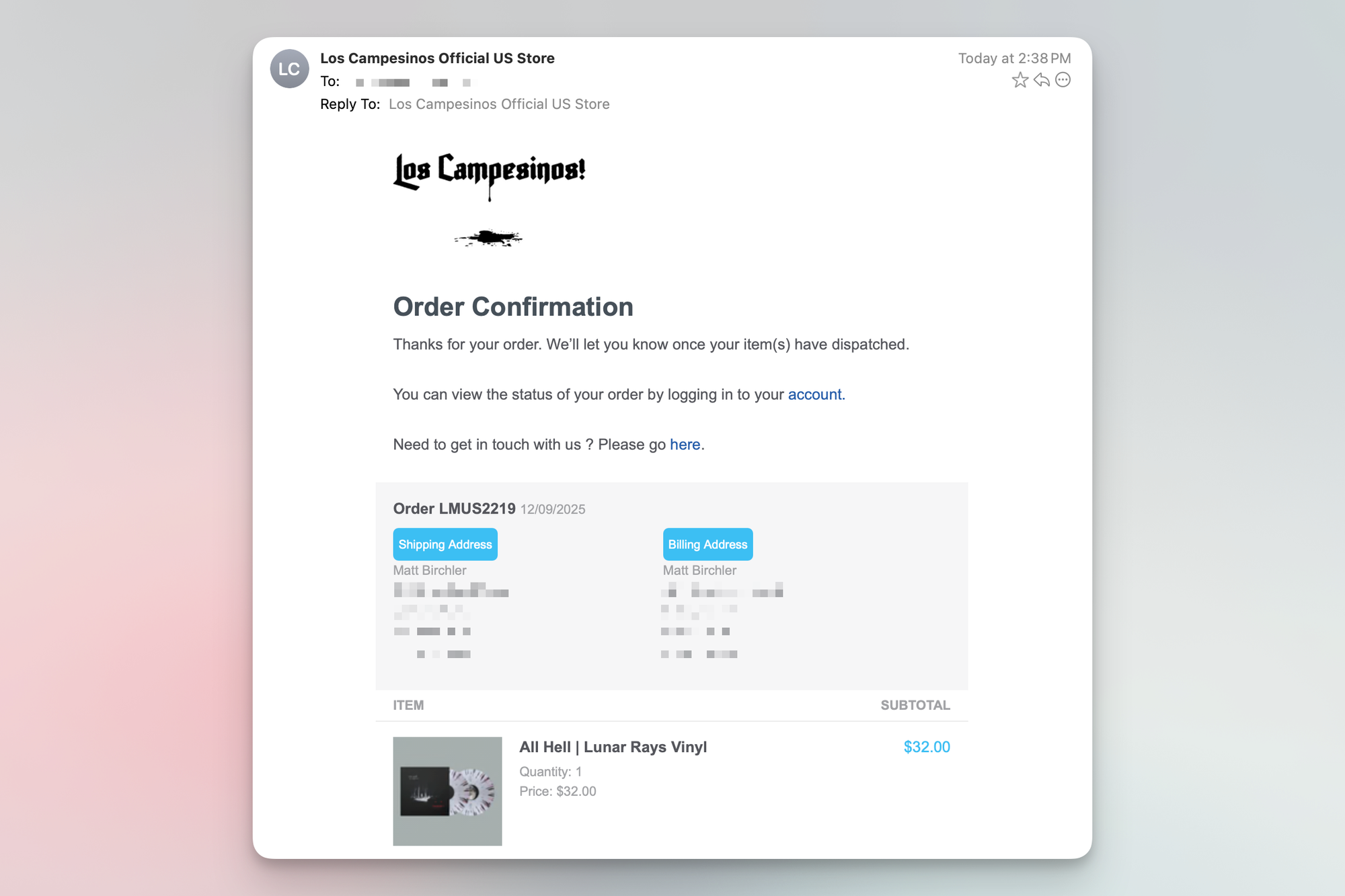
I was feeling kind of down after writing these two posts today, so I took the opportunity to put my money where my mouth is and bought Los Campesinos! latest album direct from them. By my quick math, this one act did as much good as 8,205 streams would have done them.
I'll close this post with the same thing I said in that first one:
If you want to actually support your favorite artists, buy their music outright. Bandcamp is a good option here, and direct from the artist is even better